
L-6 Hard Disk ▶️
L-6.1: Hard Disk Architecture in Operating System in Hindi
Section titled “L-6.1: Hard Disk Architecture in Operating System in Hindi”Hard Disk Architecture 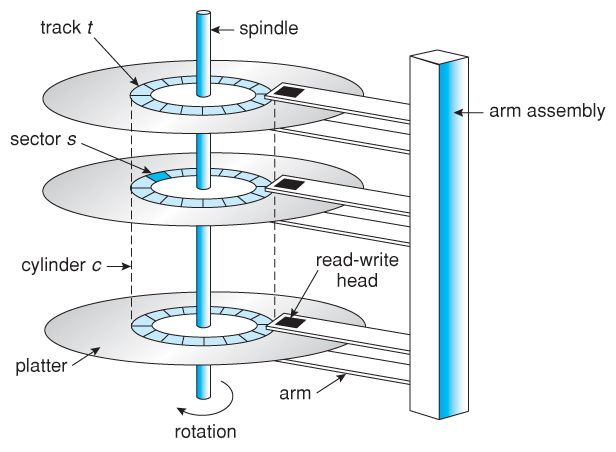
- Rotation -> Uni-direction -> Clockwise or Anticlockwise
- Platter -> Surface -> Track -> Sectors -> Data
- Total Disk Size = No. of Platters x No. of Surface in Each Platter x No. of Tracks in Each Surface x No. of Sector in Each Track x Data Per Sector
For Calculations Remember Powers of 2
2^1=2, 2^2=4, 2^3=8, 2^4=16, 2^5=32, 2^6=64, 2^7=128, 2^8=256, 2^9=512, 2^10=1024, 2^11=2048, 2^12=4096, 2^13=8192, 2^14=16384, 2^15=32768
1 K = 2^10 ~ 10^31 M = 2^20 ~ 10^61 G = 3^30 ~ 10^91 T = 2^40 ~ 10^12
Ques: Find No. of bits Required and Memory Size of the Disk With. 8 Platters, 256 Tracks on each surface, 512 Sector on Each Track and 512KB on each Sector
Ans: Memory Size = P * 2 Surface By default * T * S * D =
No. of Bits =
L-6.2: Disk Access Time with Example | Seek Time, Rotational Time and Transfer Time
Section titled “L-6.2: Disk Access Time with Example | Seek Time, Rotational Time and Transfer Time”Disk Access Time
- Seek Time -> Time taken by Read/write head to reach desired track.
- Rotation time -> Time taken for one full Rotation (360.)
- Rotational Latency -> Time taken to reach desired sector.
- ~ Average of All rotations
- Transfer Time ->
- Transfer Rate (Data Rate) ->
L-6.3: Disk Scheduling Algorithm | Operating System
Section titled “L-6.3: Disk Scheduling Algorithm | Operating System”Goal -> To minimize the seek time (no. of tracks Movement)
- The whole track is read in one go, so the scheduling depends on the seek time (time to reach a track).
- It is done by Actuator Arm back(outside) and Forth (inside) movement.
Disk Scheduling Algorithms:
- FCFS (First come first Serve)
- SSTF (Shortest Seek time first) -> Nearest Cylinder Next
- SCAN -> Elevator Algorithm
- LOOK
- CSCAN (Circular Scan)
- CLOOK (Circular Look)
Common Ques for All Algorithms
Section titled “Common Ques for All Algorithms”Ques A disk Contains 200 tracks. Request queue contains track no. (82, 170, 43, 140, 24, 16, 190) respectively. Current Position of R/W head = 50 -> Calculate total no. of tracks movement by head using All Algorithms -> If R/W head takes 1ns to move from one track to another then total time taken ___ ?
L-6.4: FCFS in Disk scheduling with Example | Operating System
Section titled “L-6.4: FCFS in Disk scheduling with Example | Operating System”FCFS Advantage -> No Starvation Disadvantage -> Performance (No optimisation)
Ans: Seek Time = abs(82-50) + abs(170-82) + abs(43-170) + abs(140-43) + abs(24-140) + abs(16-24) + (190-16) = 642 => (82-50) + (170-82) + (170-43) + (140-43) + (140-24) + (24-16) + (190-16) = 642
         50->82            └82-------->170┐      ┌ 43<-------------170┘      └ 43---------->140┐     24<-------------140┘  ┌16<-24┘    └16------------------>190
Back-n-Forth170-50 + 170-43 + 140-43 + 140-16 + 190-16 = 642Total Time taken = 642ns
L-6.5: SSTF in Disk scheduling with Example | Operating System
Section titled “L-6.5: SSTF in Disk scheduling with Example | Operating System”SSTF
- Advantage -> Least Seek time (Average cases), Less Response time
- Disadvantage -> Starvation, More Overhead to find nearest
         43<-50     24<-43   16<-24   16--------------->82                     82--->140                           140-->170                                 170->190
(50-16)+(190-16) = 208Total Time Taken = 208 ns
L-6.6: SCAN Algorithm in Disk scheduling with Example | Operating System
Section titled “L-6.6: SCAN Algorithm in Disk scheduling with Example | Operating System”SCAN:
- Advantage -> It work as an ‘Elevator’ Algorithm it means, in Initial Direction Track Move Upto the Last Track (0 or n-1) to full fill the need of some new request at runtime
- Disadvantage -> If Dynamically a New Request come after, Direction change from edge toward different edge, than it need to wait for long time to come back
Direction Given: Starting Direction toward larger value
             50--->82                   82--->140                         140-->170                               170->190                                    190->199           43<-----------------------------199     24<-43   16<-24
(199-50)+(199-16) = 332Total time taken = 332ns
L-6.7: LOOK Algorithm in Disk scheduling with Example | Operating System
Section titled “L-6.7: LOOK Algorithm in Disk scheduling with Example | Operating System”LOOK Same as SCAN with Track not goes upto the edge tracks without need.
Direction Given: Starting Direction toward larger value
             50--->82                   82--->140                         140-->170                               170->190           43<------------------------190     24<-43   16<-24
(190-50)+(190-16) = 314Total time taken = 314 ns
L-6.8: C-SCAN Algorithm in Disk scheduling with Example | Operating System
Section titled “L-6.8: C-SCAN Algorithm in Disk scheduling with Example | Operating System”C-SCAN -> Circular Scan
50->82->140->170->190->(199) Rightmost ->Left Most (0) -> 16 -> 24 -> 43
(199-50) + (199-0) + (43-0) = 391
L-6.9: C-LOOK Algorithm in Disk scheduling with Example | Operating System
Section titled “L-6.9: C-LOOK Algorithm in Disk scheduling with Example | Operating System”50->82->140->170->190-> Left ->16 -> 24 -> 43
(199-50) + (190-16) + (43-16) = 341