
INS (DTU CO415) Endsem
Euler’s Toient Function Explained with Examples in Hindi #38
Section titled “Euler’s Toient Function Explained with Examples in Hindi #38”ϕ(n) for [n>=1] is defined as the number of positive integer less than n that are coprime to n
Note: two number are coprime if the greater common divisior (gcd) of them are 1; a & b are coprime if gcd(a,b)=1 ex: gcd(5,7) =1 -> 5 and 7 are coprime
ϕ(5) = 4 because positive and coprime no. less then 5 are { 1, 2, 3, 4} ϕ(6) = 2 because positive and coprime no. less then 6 are { 1, 5}
Formula to Calculate Euler’s Totient Function
- If
nis a prime number- ϕ(n) = n-1
- ex: ϕ(23) = 22
- If
nis not a prime number- ( where a & b are coprime)
- ex:
Euler’s Theorem Explained with Examples in Hindi
Section titled “Euler’s Theorem Explained with Examples in Hindi”Euler’s Theorem is a fundamental result in number theory, often used in cryptography, particularly in algorithms like RSA (Rivest-Shamir-Adleman). In the context of information and network security, it plays a key role in ensuring secure communication by enabling efficient modular exponentiation and key generation.
Euler’s Theorem:
Section titled “Euler’s Theorem:”Euler’s theorem states that if two numbers x and n are coprime (i.e., they have no common divisors other than 1), then:
Euler’s Theorem:
- (i.e. is when divided by n , give remainder 1)
ex: x =4 n = 165 GCD(4,165)=1 -> coprime
Note : If x and n are coprime then
- ≡ (for all positive no. a)
A number a is a primitive root modulo n if every number coprime to n is congruent to a power of a modulo n
simply, a is said to be a primitive root of prime number p, if a^1 mod p , a^2 mod a^3 mod p, … a^(p-1) mod p are distinct
Example: Primitive root of prime number 5: = = 2 = = 4 = = 3 = =1
So 2 is primitive root of 5 because, the above equation gives all no. from 1 to 5
Note: the order or the numbers are unpredictive
Similarly,
Ques. Is 3 is primitive root of 7 ? -> Yes = = 3 ✅ = = 2 ✅ = = = 6 ✅ = = = 4 ✅ = = = 5 ✅ = = = 1 ✅
Ques. Is 2 is primitive root of 7 ? -> No = = 2 ✅ = = 4 ✅ = = 1 ✅ = = 2 ❌ Repeat = = 4 ❌ Repeat = = 1 ❌ Repeat
Fermat’s Theorem Explained with Examples in Hindi #47
Section titled “Fermat’s Theorem Explained with Examples in Hindi #47”It’s Special case of Euler’s Theorem ( ) Where n is a prime no. If n is prime no. ϕ(n)= n-1
Fermat’s Theorem:
ex: x=3 n=5
ex: x=3 n=5
243 = 3mode5
Conclusion This is the theorem , that would be required to understand and deal with public/private RSA
The Chinese Remainder Theorem (Solved Example 1)
Section titled “The Chinese Remainder Theorem (Solved Example 1)”The Chinese Remainder Theorem (CRT) is used to solve a set of different congruent equations with one variable but different moduli which are relatively prime as shown below:
Note: for i≠j
…
CRT states that the above equations have a unique solution of the moduli are relatively prime.
where,
Example 1: Solve the following equations using CRT
Solution:
Given , , , ,
To find :
-> 1❌, 2✅ -> 1✅ -> 1✅
Verify: ✅ ✅ ✅
The discrete logarithm problem (DLP) is a mathematical challenge that involves finding an integer x that satisfies the equation g^x=h (mod p).
- The DLP is considered computationally hard, meaning there is no known efficient classical algorithm for computing discrete logarithms in general.
Understanding of DLP
Here 5 is primitive root of 17
= 5
= 8
= 6
= 13
= 14
= 2
= 10
= 16
= 12
= 9
= 11
= 4
= 3
= 15
= 7
= 1
Unique result for a^x mod n where (a is primitive root of n and , x = 1 to n-1)
One-way function: Function with property, finding solution is easy in one direction, but hard in the reverse direction
Finding `?`
------Easy------->5^9 MOD 17 = ?
<-----Difficult---5^? MOD 17 = 12- ; X = 2, 5, etc.
- For smaller value of
pis may be easy to find x. - If
pis very large, then findingXis hard. - if
pis large, then the time and effort to findXis very hard. - The strength of one-way function is depending on how much time it takes to break it.
The Discrete Logarithm Problem (Solved Example) #50
Section titled “The Discrete Logarithm Problem (Solved Example) #50”Example 1: Solve Solution : Here, p=11, g=2, X=9 -> -> ->
Try n = 1, 2, 3, …
n | X |
|---|---|
| 1 | = 2 ❌ |
| 2 | = 4 ❌ |
| 3 | = 8 ❌ |
| 4 | = 5 ❌ |
| 5 | = 10 ❌ |
| 6 | = 9 = 9 ✅ |
| Ans : 6 |
Principle of Public Key Cryptography
Section titled “Principle of Public Key Cryptography”It answer whether a given number is prime no. or not.
Is ‘p’ prime?
Test: = multiple of p —> `p’ is prime if this is a multiple of ‘p’ for all 1<=a<p.
Example: Is ‘5’ prime?
Solution:
-> ‘p’ is prime if this is a multiple of ‘p’ for all 1<=a < p.
a = 1, 2, 3, 4.
∴ 5 is prime
Drawbacks of Fermat’s Primarily test :
- If prime number is very large, we need to carry out the process, from a = 0, 1, 2 … (p-1) or
a^p-anon multiple ofpand so time consuming. - Accuracy is not 100%. (ex: 561=3x11x17 is a composite no., but fermat’s test say its prime no.)
~ Michael Oser Rabin & Gary Lee Miller
Miller-Rabin Primality Test
- Miller-Rabin primality test or Rabin-Miller primality test.
- It perform Probabilistic primality test.
- Similar to Fermat primality test and the Solovay-Strassen primality test.
- Checks whether a specific property, which is known to hold for prime values, holds for the number under testing.
Algorithm :
-
To test whether
nis prime no. or not Step 1: Find Step 2: Chooseasuch that1<a<n-1Step 3: Compute if then Composite if Probably Prime -
if neither +1 or -1, move to next value of until find +1 or -1
Is 561 prime?
Solution: Given n = 561
Step 1:
So k=4, and m=35
Step 2:
Choosing a=2; 1<2<560
Step3:
Compute
(above expression Solved using modular exponentiation, study it)
not +1 or -1
$b_1 = b_0^2(mod n)$$b_1=263^2(mod 561) = 166$$b1 =$ not +1 or -1
$b_2 = b_1^2(mod n)$$b_2=166^2(mod 561) = 67$$b2 =$ not +1 or -1
$b_3 = b_2^2(mod n)$$b_3=67^2(mod 561) = 1$$b1 =$ +1561 -> composite no.
RSA Algorithm in Cryptography and Network Security
Section titled “RSA Algorithm in Cryptography and Network Security”RSA (Rivest-Shamir-Adleman) developed in 1978
- It is an asymmetric cryptographic algo. (2 keys) i.e. public and private key concept is used here.
- Public key - known to all users in Network
- Private key - Kept secret, not sharable to all.
If public key of user A - is used for encryption, we have to use the private key of same user for decryption
The RSA Scheme is a block cipher in which the plain text and cipher text are integers b/w 0 and n-1 for some value n.
RSA (Rivest-Shamir-Adleman) is a widely used public-key cryptosystem for secure data transmission. It was developed by Ron Rivest, Adi Shamir, and Leonard Adleman in 1977.
RSA is based on the mathematical fact that it is easy to multiply large prime numbers together, but it is hard to factorize the resulting product.
-
Public and Private Keys:
- Public Key: Used to encrypt the message and can be shared openly.
- Private Key: Used to decrypt the message and must be kept secret.
-
How RSA Works:
- Key Generation:
- Choose two large prime numbers,
pandq. - Compute
n = p*q.nis used as the modulus in both the public and private keys. - Compute Euler’s totient function
ϕ(n) = (p-1)(q-1).- i.e. find number of coprime of
nSmaller then n
- i.e. find number of coprime of
- Choose a public exponent
esuch that1 < e < ϕ(n)and `gcd(e,ϕ(n)) = 1.- i.e. select one
efrom the coprime ofnthat are smaller than n
- i.e. select one
- using the extended Euclidean algorithm, Compute the private exponent
dsuch thate*d ≡ 1 mod ϕ(n)- i.e. find smallest Integer
dusingd*e = 1 + Kϕ(n)by trying different values of K=0, 1, 2, 3…
- i.e. find smallest Integer
- The public key is
(e, n)and the private key is(d, n).- e=public key, d=private key
- Choose two large prime numbers,
- Key Generation:
Ques. In a RSA cryptosystem a particular A uses two prime no. p=13 and q=17 to generate his public and private keys. If the public key of A is 35. Then find the private key of A
Step 1: choose two different large random no. p and q
p=13 , q =17 (Given)
Step 2: Calculate n = p*q
n = p* q = 221
Step 3: Calculate ϕ(n)=(p-1)*(q-1).
ϕ(221) = 12 * 16 = 192
Step 4: choose e such that 1<e<ϕ(n) such that gcd(e,ϕ(n))=1
e=35 (Given)
Step 5: Calculate d, such that d*e ≡ 1 mod ϕ(n)
find d = (1 + Kϕ(n))/e for k=0, 1, 2,…
for K=0, d = 0.02
for K=1, d = 5.5
for K=2, d = 11 ✅
so d = 11
Step 6: public key = 35 private key = 11
Given (e,n) it is hard to find d.
- Easy for an attacker who knows
n=p.qthe factors of n - such attacker could compute
dusing ,ϕ(n)=ϕ(p)*ϕ(q) = (p-1)(q-1)
- Showing that all ways of breaking RSA would allow easy ways to factor n.
- Claim that factoring
nis hard.
Diffie Hellman Key Exchange Algorithm | Cryptography and Network Security
Section titled “Diffie Hellman Key Exchange Algorithm | Cryptography and Network Security”Diffie-Hellman Key Exchange
Section titled “Diffie-Hellman Key Exchange”(i) It is not an encryption algo (ii) Used to exchange secret keys between 2 users (iii) We will use asymmetric encryption to exchange the secret key between users.
Why to use such algorithm?? -> Because when we are sending a key to receiver, it can be attacked in between.
Diffie-Hellman Algorithm:
Section titled “Diffie-Hellman Algorithm:”- Choose Prime no. and Primitive Root
- Consider a prime number
q - Select
αsuch that it must be the primitive root of q andα<q
- Consider a prime number
α is a primitive root of q if
α MOD qα^2 MOD qα^3 MOD qα^(q-1) MOD q
gives results {1, 2, 3, ....q-1}
ex: 3 is primitive root of 7, 5 is primitive root of 7- Key Generation of Person 1
- Assume (Private Key of A) and
- Calculate (Public Key of A)
- Key Generation of Person 2
- Assume (Private Key of B) and
- Calculate (Public Key of B)
- Calculate the Secret Key (using another’s public key)
KA=KBThus the Secret KeyKAandKBare Exchanged.
Example
Section titled “Example”- Let
q=7(prime) - let
α=5(primitive root of q) - Assume
XA=3() - Calculating Public Key
YA=6( = ) - Assume
XB=4() - Calculate Public Key
YB=2( = ) - Calculate Secret Key
KA=1( = ) - Calculate Secret Key
KB=1( = ) KA=KBThus the Secret KeyKAandKBare Exchanged.
Note: Both of them don’t need any information from anyone. They just use α and q which are global (known to all).
Person 1 Global Elements Person 2(A) ┌────────────┐ (B) │ q=7, α=5 | └────────────┘ ┌────────────┐XA=3 │ YA=6, YB=2 │ XB=4 └────────────┘ Public KeysElliptic Curve Cryptography | ECC in Cryptography and Network Security
Section titled “Elliptic Curve Cryptography | ECC in Cryptography and Network Security”Elliptic Curve Cryptography
Section titled “Elliptic Curve Cryptography”Elliptic Curve Cryptography (ECC) is a public key cryptography method based on the algebraic structure of elliptic curves over finite fields. It is known for providing high security with smaller key sizes compared to other cryptographic systems like RSA, making it more efficient in terms of performance and resource usage.
- It is asymmetric public key cryptosystem.
- It provides equal security with smaller key size (eg: as compared to RSA and other non ECC algorithms.)
- => Small key size and high security
- It makes use of Elliptic curves
- Elliptic curves are defined by some mathematical functions - Cubic Functions
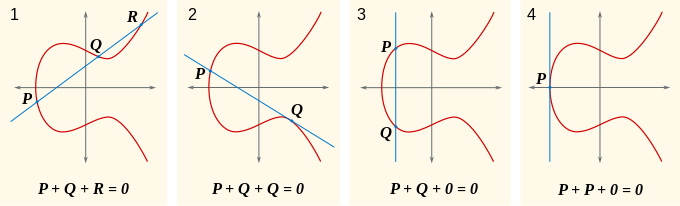
- It is Symmetric to X-axis
- If we draw a line, it will touch a max of
3points - It is a Trapdoor function. Trapdoor Function: a function that is easy to compute in one direction, yet difficult to compute in the opposite direction (i.e. finding its inverse) without special information, called the trapdoor
          easy     x  ------------> f(x)        <------------         Difficult
but easy ( if givent 't'-> trapdoor) x <----------- f(x)- Let be the elliptic curve.
- Consider the equation
Q=k.P( whereQ,P-> points on curve and K<n) - Trapdoor / One way function
- easy to find
Q(If wekandPgiven) - extremely difficult to find
k(if we knowQandP) - This is called the discrete logarithm problem for elliptic curves
- easy to find
ECC - Key Exchange Algorithm
Section titled “ECC - Key Exchange Algorithm”- Global Public Elements
- : Elliptic curve with parameters a, b and
q(q = prime no. or an integer of the form 2^m) - G : Point on the elliptic curve whose order is large value of
n
- : Elliptic curve with parameters a, b and
- User A Key Generation
- Select Private Key
nA(nA<n) - Calculate Public Key
PA->
- Select Private Key
- User B Key Generation
- Select Private Key
nB(nB<n) - Calculate Public Key
PB->
- Select Private Key
- Calculation of Secret Key by user A & B
KA=KB=
- `KA=KB
A -----------> Bsender ReceiverECC Encryption
Section titled “ECC Encryption”- Let the message be
M - first encode this message
Minto a point on elliptic curve- Let this point be
Pm(Now this point is encrypted)
- Let this point be
- for encryption chose a random positive integer
k - The cipher point will be
- For encryption public key of receiver (B) is used
- This point will be sent to the receiver
ECC Decryption
Section titled “ECC Decryption”- For decryption, multiply 1st point in the pair with receiver’s secret key
- Then subtract it from 2nd point/ coordinate in the pair
- but we know , substitute it
- => =
Pm(Original point) - so receiver gets the same point
This formulation clearly separates the components of the cipher pair for encryption and decryption in terms of C1C_1 and C2C_2.
Table of NIST Recommended Key Sizes
Section titled “Table of NIST Recommended Key Sizes”| Symmetric Key Size (bits) | RSA and Diffie-Hellman Key Size (bits) | Elliptic Curve Key Size (bits) |
|---|---|---|
| 80 | 1024 | 160 |
| 112 | 2048 | 224 |
| 128 | 3072 | 256 |
| 192 | 7680 | 384 |
| 256 | 15360 | 521 |
Significance of Elliptic Curve Cryptography (ECC) over RSA:
Section titled “Significance of Elliptic Curve Cryptography (ECC) over RSA:”-
Smaller Key Sizes:
- ECC achieves equivalent security with significantly smaller key sizes than RSA.
- Example: A 256-bit ECC key provides similar security to a 3072-bit RSA key.
-
Performance:
- ECC computations are faster and require less processing power compared to RSA, making it ideal for devices with limited resources like IoT devices and smartphones.
-
Reduced Bandwidth:
- Smaller keys mean less data is exchanged during encryption processes, improving performance in bandwidth-constrained environments.
-
Enhanced Security:
- ECC is based on the mathematical difficulty of the Elliptic Curve Discrete Logarithm Problem, which is harder to break than the integer factorization problem on which RSA relies.
-
Energy Efficiency:
- ECC requires less energy for computations, making it suitable for battery-powered devices.
-
Longevity:
- As computational power grows, ECC is better positioned to remain secure with smaller key sizes compared to RSA, which would require impractically large keys in the future.
Authentication functions and 3 ways to produce authentication | Message authentication
Section titled “Authentication functions and 3 ways to produce authentication | Message authentication”- Raman ----------> John ->It is one of the 5 principles of security ->Authentication -> Verifying the users identity ->An authenticator must be there to authenticate the message
Types of Authentication or Types of function to produce authentication
Section titled “Types of Authentication or Types of function to produce authentication”- Message Encryption : Cipher text act as authenticator
- MAC (Message authentication code: We will have some authentication function
cand we apply them on the plain textMalong with the keyKwhich produces a fixed length code called MAC that act as a authenticator.c(M,K)=fixed length code(MAC) - Hash Function(H): It is Independent of Key, produce fixed length code
hthat act as authenticator `H(M)=fixed lenght code (Hash code ‘h’)
1. Message Encryption
Section titled “1. Message Encryption”- Cipher text is an authenticator
A. Symmetric Key Encryption : Key K1 shared only between sender and receiver only
Section titled “A. Symmetric Key Encryption : Key K1 shared only between sender and receiver only”sender(A) cipher text receiver(B)
[M]--->(E)--->[//M//]--->(D)--->[M] ↑ ↑ K K- Authentication✅ Confidentiality✅
B. Asymmetric encryption : Receiver Public key for Encryption, and Receiver Private Key for Decryption
Section titled “B. Asymmetric encryption : Receiver Public key for Encryption, and Receiver Private Key for Decryption”sender(A) cipher text receiver(B)
[M]--->(E)--->[//M//]--->(D)--->[M] ↑ ↑ KPuB KPrB- Authentication❌ Confidentiality✅
C. Asymmetric encryption : Senders Private key for Encryption, and Senders Public Key for Decryption
Section titled “C. Asymmetric encryption : Senders Private key for Encryption, and Senders Public Key for Decryption”sender(A) cipher text receiver(B)
[M]--->(E)--->[//M//]--->(D)--->[M] ↑ ↑ KPrA KPuA- Authentication✅ Confidentiality❌
D. Asymmetric Encryption : To get both, authentication and confidentiality, and also signature. Use dual encryption and Decryption
Section titled “D. Asymmetric Encryption : To get both, authentication and confidentiality, and also signature. Use dual encryption and Decryption”sender(A) cipher text receiver(B)
[M]-->(E)-->[/M/]-->(E)-->[//M//]-->(D)-->[/M/]-->(D)-->[M] ↑ ↑ ↑ ↑ KPrA KPuB KPrB KPuA- Authentication✅ Confidentiality✅ Note: We also get Digital Signature because, we are using private key of senders for encryption
2. MAC in Cryptography || Message Authentication Code in Cryptography and network security
Section titled “2. MAC in Cryptography || Message Authentication Code in Cryptography and network security”-> We will use a secret key to generate a small fixed size block of data called MAC or cryptographic checksum
-> It is then appended with the message. -> The communicating parties will share a secret common key which will be use to create the MAC
When A sends a Msg to B, it calculates the MAC as a function of the message and the key.
MAC = C(K,M)
Where:
- M= input message
- C=MAC function
- K=shared secret key
A. MAC for Authentication
Section titled “A. MAC for Authentication” . KSender append . ┌-----┐ ↓[Msg]--------->(||)---->| Msg |----(C)----↓ compare | ↑ . |-----| (= or !=)? ↓ | . | MAC |-----------↑(Mac Func C)-----┘ . └-----┘ ↑ . K .
Comparison:if equal message is authentic- Authentication✅ Confidentiality❌
B. MAC for Authentication and Confidentiality (tied to Plain text i.e. [Msg|MAC])
Section titled “B. MAC for Authentication and Confidentiality (tied to Plain text i.e. [Msg|MAC])” K2Sender append ┌-------┐ ↓[Msg]-->(||)---[Msg|MAC]---(E)-->|//Msg//|---(D)---[Msg|MAC]-----↓ compare | ↑ ↑ |-------| | (= or !=)? ↓ | K2 |//MAC//| └---(C)------↑(C)------┘ └-------┘ ↑ ↑ K1 K1- Authentication✅ Confidentiality✅
B. MAC for Authentication and Confidentiality ( tied to Cipher text i.e. [//Msg//|MAC] )
Section titled “B. MAC for Authentication and Confidentiality ( tied to Cipher text i.e. [//Msg//|MAC] )” ↑ K1->(D) K1 | K2 K1Sender ↓ cipher append ┌-------┐ ↓ ↓[Msg]-->(E)--[//Msg//]-->(||)--->|//Msg//|----(C)----(D)-----↓ compare | ↑ |-------| (= or !=)? ↓ | | MAC |-------------------↑(C)-----------------------┘ └-------┘ ↑ K2
M---->E(M,k)---------->[C(M,k2),(E(M,k1))]-->E(M,k1)-->M (Make this type of function for all diagram above and below)- Authentication✅ Confidentiality✅
Significance of MAC i. ensures that receiver knows whether the msg has been altered or not ii. authentication ensured - receiver is ensured that the message come from the correct sender
Difference between MAC B and C
Section titled “Difference between MAC B and C”- B: Encrypt-and-MAC can miss tampering with encrypted data.
- Limitation: The MAC is created before encryption. So, if someone modifies the encrypted data (ciphertext), the system might not detect it.
- Ex: Used in file transfers (e.g., SFTP).
- Limitation:
- C: Encrypt-then-MAC is better because it checks for tampering in both the plaintext and the ciphertext.
- Limitation: The MAC is created after encryption, so it protects both the message and the encrypted data. If someone tampers with the ciphertext, it will fail verification.
- Ex: Used in TLS for secure communication.
Hash function
Section titled “Hash function”- It is similar to MAC but it does not use a key
- It takes in variable size message and produce fixed size output Called Hash code ( Hash Value or Message Digest)
- The only input in the message is message
M - A hash value
his generated by a functionH(Also called compression function )H(M)=h(fixed length code)
Different Hash methods to provide authentication in different situations
Section titled “Different Hash methods to provide authentication in different situations”Symmetric
Section titled “Symmetric”1 E(M|h) ![[Pasted image 20241121001215.png]] Authentication✅ Confidentiality ✅
2 M|E(h) . Reduce processing time ![[Pasted image 20241121001355.png]] Authentication✅ Confidentiality ❌
Asymmetric
Section titled “Asymmetric”3 M|E(h) . Reduce processing time ![[Pasted image 20241121001921.png]] Authentication✅ Confidentiality ❌
4 E(M|E(h)) : Asymmetric(private key) for signing algorithm + Symmetric for Confidentiality ![[Pasted image 20241121002112.png]] Authentication✅ Confidentiality ✅
Secret code
Section titled “Secret code”- above h = H(M)
- here hs=H(M|S)
5 M | hs ![[Pasted image 20241121002634.png]] Authentication✅ Confidentiality ❌
6 E(M | hs) , Secret Code for signing algorithm + Symmetric for Confidentiality ![[Pasted image 20241121003156.png]]
#42 Public key Infrastructure (PKI), Architecture Of PKI|CNS|
Section titled “#42 Public key Infrastructure (PKI), Architecture Of PKI|CNS|”Public key Infrastructure (PKI)
Section titled “Public key Infrastructure (PKI)”- It is a standard followed for managing, storing and revoking the digital certificate
- It follows asymmetric key cryptography
- It includes:
- Message Digests - for Integrity
- Digital Signature - for Authentication and Non-Repudiation
- Encryption Services - for Confidentiality
Note:
- Authentication : -> authenticate message come from correct person
- No-Repudiation:-> The receiver cannot deny
- Confidentiality:-> Only the authorized receiver can access the message.
Architecture of PKI : It consists of 4 parts
- Certificate Repository : Store Certificates + Info.
- Entity - User (Single Person, Organization or Router)
- Registration Authority (RA) - Register and Verify User
- Certification Authority (CA) - Decide if It would give certificate or not, or for how much time it would give access to the user
#26 Symmetric Key Distribution - Methods |CNS|
Section titled “#26 Symmetric Key Distribution - Methods |CNS|”Key Distribution in Symmetric Key
Section titled “Key Distribution in Symmetric Key”- Physical Delivery : directly meeting the receiver (but it take time)
- Key Distribution Center (KDC) : Generate the key and send to sender and Receiver (but you should be rely on third party)
- Using Previous keys : Generate new key by encrypting it using old key
- Using Third Party : In place of (A->B) use (A->C->B)
#37 Digital Signature In Cryptography |CNS|
Section titled “#37 Digital Signature In Cryptography |CNS|”Digital Signature
Section titled “Digital Signature”- It is used for authentication and Non-Repudiation
- It is a Asymmetric key cryptography
- Encryption : using private key of sender
- Decryption : using public key of sender
- It is used for authentication (comes from correct person)
-> Signature : Proof of Identity : is it from correct sender/ or not
                                                       (Y)          [M]───────────────┐                        |           ↓                |                        ˅    ┌─────────────────┐     |   ┌───┐       ┌─────────────────┐(X)->  │ Digital Sign.   │     └── | M | =>    │ Digital Sign.   │    │ Generation Algo.│     ┌── ├───┤       │ Generation Algo.│    └─────────────────┘     |   | S |       └─────────────────┘           ↓                |   └───┘               |          [S]───────────────┘                       ˅                                                  Valid or not
X - Private KeyY - Public KeyIf msg match -> valid otherwise nto
DSS ensures :
- Receiver can verify the claimed identity of the sender
- Sender cannot later repudiate the contents of the message
- Receiver cannot possibly have manipulated the message itself
GPT A Digital Signature primarily uses a hash function and encryption (not MAC) as part of its operation. Here’s a breakdown:
- Hash Function:
- A hash function (e.g., SHA-256) is used to create a fixed-size digest (or hash) of the original message.
- The hash ensures integrity (any change in the message will result in a completely different hash).
- Encryption:
- The hash is encrypted using the sender’s private key (asymmetric encryption) to create the digital signature.
- This ensures authenticity (only the sender’s private key could have created the signature) and non-repudiation (the sender cannot deny their involvement).